Monday, December 15, 2014

RealSmart Holiday Party 2014

photo 1
This holiday season, the RealSmart Team headed to Sur la Table in Palo Alto to try to learn how to cook.  Needless to say, most of us are still hacks in the kitchen, but hey! We had fun all the same.
Even though we're definitely in need of some follow-up classes, the folks at Sur la Table were great and we highly recommend them to anyone looking for a stress-free cooking class (plus they let you bring your own beer and wine!).  The head chef, Joel, was fun, knowledgeable, and very adept at dumbing down his language just enough for us to be able to understand his instructions.  And while we were given plenty of opportunities to get our hands dirty, the staff was wise in only trusting us with a small a fraction of the cooking (this way they could make sure that the final product was actually edible).
What we Made:
-arugula salad with homemade vinaigrette
-roasted honey-glazed chicken
-mushroom risotto
-roasted asparagus with browned butter sauce (DELICIOUS)
-chocolate tart with fresh berries and whipped cream
When we finished cooking and eating, they provided us with the recipes to all of the dishes we prepared and a discount to the store, which by the way, is a great place for Christmas shopping.
RealSmart's First Annual Ugly Christmas Sweater Contest!

photo 2I thought my sweater was the ugliest, and Denis actually wore his grandma's Christmas sweater, but it was Laurie who went the whole nine yards.  She wrapped herself in Christmas lights, pinned ornaments across her sweater, and even donned an ugly hat.  So congratulations Laurie! You are the official Champion of RealSmart's first annual ugly Christmas sweater contest!


Tuesday, December 9, 2014

2015: The Year of The Millennial?

Young, wired and living life on the digi by TheeErin, on Flickr
Photo by  TheeErin 
Recent economic recovery has created a lending environment that is far more hospitable to the millennial age group (those born 1980-1999) than any we have seen in the past several years.  The re-emergence of products like mortgages with loan-to-value ratios of 85-90%, lender paid mortgage insurance, and mortgages to borrowers who are shouldering debt-to-income ratios of up to 50%, have allowed for many more people to enter the home buying discussion.  These products are particularly advantageous to millennial home buyer hopefuls, who have often been kept out of the market because of large amounts of student debt and/or because sky high rental prices have prevented them from saving enough for a down payment.
Millennials are also disproportionately benefiting from the recent job growth.  According to Realtor.com chief economist, Jonathan Smoke, the under-35 population has seen job growth at a 60% better pace than the rest of the population.
Largely due to the reasons listed above, forecasts released by both Realtor.com and Zillow suggest that millennials will be making their triumphant return to the housing market next year.   Realtor.com predicts that millennials will make up around 65% of first-time home buyers in 2015, and Zillow chief economist Stan Humphries said in a report released Tuesday that, “roughly 42% of millennials say they want to buy a home in the next one to five years compared with just 31% of generation X.”  He also went on to claim that by the end of next year millennials will be the largest home-buying age group.
Unfortunately, those of us living in the SF Bay Area will probably not play much of a part in the return of the millennial home buyer.  It is expected that low inventory will continue to drive up home prices, making it difficult for first time buyers to enter the market.  Even so, loosening mortgage requirements and continued job growth should set the stage for Bay Area millennials at some point down the road.  And with rental prices as high as they are, first time buyers should consider buying sooner rather than later, so they can start investing their monthly payments rather than handing them to a landlord.
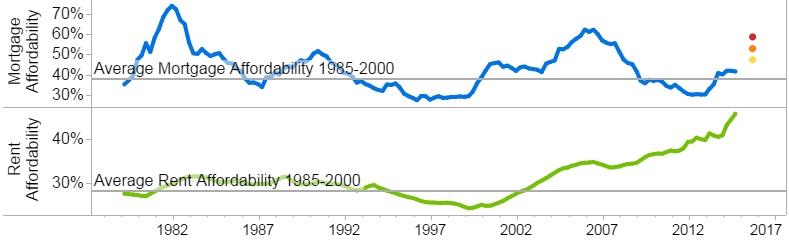
The graphic below shows the rent and mortgage affordability for San Francisco as calculated by Zillow.  As you can see, the difference between the two is negligible.
Screenshot 2014-12-09 14.27.12


Tuesday, December 2, 2014

RWC: City Hall Seeks Public Opinion to Help Shape Community Benefits Program

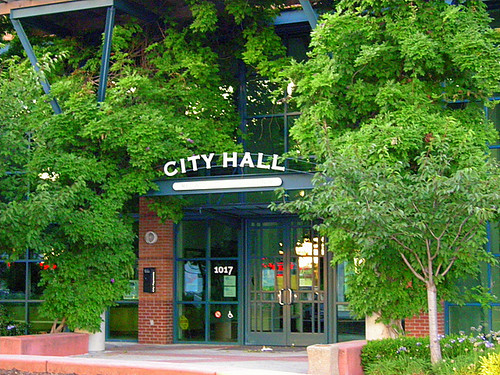
Redwood City City Hall by Ed Bierman, on FlickrPhoto by  Ed Bierman
Redwood City's Planning Commission will be holding a public hearing tonight - Tuesday, December 2nd at 7pm - to try to shape a community benefits program. Such a program, if enacted, would try to balance out the impact of future construction with public amenities like parks, bike lanes, additional parking, and things of that sort.  Developers would be required to fund these amenities as a condition of their project's approval.
Through past workshops and forum surveys, Redwood City residents have expressed that among their top priorities are increased parks and open space, more bike and pedestrian facilities, and affordable housing. Using this information and information gathered from tonight's hearing, a January 14th workshop will try to further pin down priority areas for the benefits program. The goal is for city council to pass an ordinance establishing the program early next year.
If a community benefits program is passed, it will not apply to any of the development that has already been approved by the city. However, this doesn't mean that developments currently underway won't include some sort of community benefit. For instance, it was recently announced that downtown's Crossing/900 development - soon to be home to Box Inc. - will include about 900 parking spaces, which during evenings and weekends will be open to the public.
To voice your concerns and opinions, attend tonight's hearing - Tuesday, December 2nd, 7p.m. at City Hall (1017 Middlefield Road).
You can also leave your comments at www.redwoodcity.org/rwcForum

Friday, November 14, 2014

Delayed Financing: Become an All-Cash Buyer

Money! by Tracy O, on FlickrPhoto by  Tracy O 
The 2008 financial crisis - brought about in large part by reckless lending – saw an immediate and dramatic tightening of mortgage loan requirements.  However, over the past couple years the market has shown significant signs of recovery, and loan requirements have begun to look a little bit more like what we were used seeing prior to 2008.  This is evident in the re-emergence of a few products that had virtually disappeared up until about a year ago.  Products like mortgages with loan-to-value ratios of 85-90%, Lender Paid mortgage Insurance, and mortgages to borrowers who are shouldering debt-to-income ratios of up to 50%.  All of this should go a long way in restoring optimism in hopeful homebuyers, but it isn’t what should be capturing headlines.
What’s more interesting is that there is an entirely new loan program that didn’t exist prior 2008, mostly because the problem that it addresses wasn’t nearly as prevalent as it is today.  This new program is called delayed financing, and it allows for a buyer to make an all-cash payment on a home and then turn around the next day and refinance.  Until earlier this year, there were seasoning requirements in place that prevented this practice.
Why would someone do this?  Well, cash buyers have a competitive edge over buyers who are taking out mortgages.  Sellers prefer cash buyers because their money is a sure thing and they make transactions quick and easy, making it hard for buyers taking out mortgages to compete.  This was never really a huge issue, but recent foreign investment has flooded the market with cash buyers, particularly in the Bay Area, and some borrowers are starting to feel the heat.
Delayed financing offers a solution to this problem.  Some people may have the ability to find enough cash to purchase a home, but doing so would leave them with no liquid assets.  Being able to take out a mortgage the day after they make a cash purchase allows them to enjoy the competitive edge they get from being a cash buyer without leaving the bank accounts empty in the process.  It essentially gives you the best of both worlds: the competitive edge of being a cash buyer, and the financial security of not having all of your money tied up in your home.

Thursday, November 13, 2014

Google Confirms Redwood City Purchase, Continues to Expand


Google has officially confirmed their $585 million purchase of six office buildings at the Pacific Shoes Center in Redwood City.  They have also confirmed their intentions to occupy said buildings.  But even with the ink still drying on their Redwood City purchase, the tech giant is continuing their dizzying pace of real estate acquisitions.
A Google subsidiary, Planetary Ventures, just leased NASA's Moffett Field for 60 years, during which time they will pay roughly 1.16 billion dollars.  The deal gives them control of a few hangars which officials say they intend to refurbish and use for research into new space exploration technology.
They also have plans to expand into San Francisco, where they have recently purchased an 8 story building on the Embarcadero.
One of the reasons that Google is likely expanding into so many different parts of the Bay Area is to resolve the commuting problems that their employees face getting to and from their Mountain View headquarters.  The Redwood City location is adjacent to the Port of Redwood City, where Google has long been toying with the idea of getting a commuter ferry running, and having real estate in San Francisco will make things a lot easier on their many employees who already live there.

Friday, November 7, 2014

Refinishing vs. Replacing Your Old Hardwood Floors


 Hardwood floors are typically fairly durable, but like any type of flooring, they take all sorts of abuse over the years. They can become warped, chipped, stained, dull, or any combination of the above, and eventually you are going to be faced with the question of whether you want to refinish or replace them. There are pros and cons to both options, and which route you take will likely be dictated by the extent of the damage to your floors and/or how much money you are willing to sink into them.
Under normal circumstances hardwood floors can go 20-30 years before needing to be refinished, and most floors can be sanded and refinished 6-7 times over their lifetime.  So unless there is significant structural damage to the planks, or to the subfloor beneath them, your hardwood can usually be professionally refinished and touched up at a much lower cost than if you were to completely replace them.  With that being said, this doesn’t mean that refinishing your hardwood floors will make them look brand new.  If your floors are severely warped, chipped, or loosened, simply sanding and refinishing them will just brighten up badly damaged floors.  Contractors can replace patches of damaged planks, or temporarily nail down loose or warped ones, but if the damage is pervasive enough, it might be best to just replace the floors altogether.

 While replacing is almost always more expensive than refinishing, the upside is that it is usually a lot quicker and easier.  Refinishing hardwood floors is a messy process that can take 4-5 days, during which time the floors can’t be touched.  It requires brushes, basecoat sealer, topcoat sealer, sanders, edgers, and a lot of dirty work.  Replacing, on the other hand, can be done with minimal mess by a professional contractor in as little as 1-4 days depending on the amount of floor that is being installed.

On a side note, if you do decide to go the replacement route, it would be worthwhile to look into engineered hardwood.  Its slightly cheaper than solid hardwood, and it stands up to humidity and weather problems better because of its multilayer composition (usually only the top 1/8” is hardwood).

If you are trying to figure out what to do with your hardwood floors, feel free to give us a call.  Our in-house licensed contractor can walk you through your options, and help you decide which one is best for you.