Friday, January 20, 2017

Major Tenant Secured for RWC Powerhouse Gym Development


On April 19th of 2016, the Redwood City Planning Commission approved a proposal to demolish an existing building at 2075 Broadway (Powerhouse Gym), and redevelop it into a 93,515 S/F mixed use building, with roughly 65,000 S/F designated for office space, and the rest for ground floor retail.  The developer, Lane Partners, had been trying to get the project pushed through for quite some time, having their initial proposal of 1750,000 S/F of office space rejected back in April 2015 due to a lack of parking.  Now, with a downsized project and planning commission approval, Lane Partners plans to break ground on the project this June, with an estimated construction duration of 20 months.
With project completion still over two years out, Lane Partners have reportedly already secured a major tenant for the development.  According to Redwood City mayor, John Seybert, the development will be an expansion site for the Chan Zuckerberg Initiative, a company formed by Facebook founder, Mark Zuckerberg, and his wife Priscilla Chan.  Per the company website, their objective is to "advance human potential and promote equality in areas such as health, education, scientific research and energy".  The couple introduced the company in December of 2015 with a pledge to contribute 99% of their shared stock in Facebook (over the course of their lifetimes), which at the time totaled roughly $45 billion.  The Initiative just recently announced the hiring of David Plouffe, campaign manager for Barack Obama's successful 2008 presidential bid, and current VP of Policy & Strategy at Uber.  Plouffe will be leading the company's policy and advocacy efforts.
The Chan Zuckerberg Initiative will be another major name added to downtown Redwood City's employer roster, which is currently headlined by Box Inc, who moved their headquarters to the new Crossing/900 development in Nov '15.  While the Chan Zuckerberg Initiative may not be huge in terms of number of people they employ, it is huge in terms of the weight carried by its name.  Having the Chan & Zuckerberg names on a brand new building just one block from the Courthouse Square is bound to have some influence on how Redwood City is perceived by businesses considering relocation in the future.

2016 Mid-Peninsula Real Estate Market in Review

The mid-peninsula real estate market told a much different story in 2016 than it did in 2014 and 2015.  While home prices continued to grow, it was at a far slower rate than the two years prior.  The average sale price for homes in the mid-peninsula grew 17.14% from 2013-2014, and 15.14% from 2014-2015. By contrast, the average sales price in 2016 saw only a 2.74% increase from 2015.  The most obvious explanation for this slow down is that inventory was significantly higher during the busiest months of 2016 than it had been in either 2014 or 2015.  In fact, in some cities inventory was nearly double its 2015 levels through much of the summer and fall months.  With more on the market, buyers became more selective, and the bidding wars that were all too common in '14 and '15, became much less prevalent in 2016.  While I'm sure most homeowners would love to see home values continue to soar indefinitely, the slowdown we saw last year was a welcome sight for buyers who felt the market had been running away from them in recent years.

* For the purposes of this update, the mid-peninsula refers to San Mateo, Foster City, Belmont, San Carlos, Redwood City & Menlo Park.
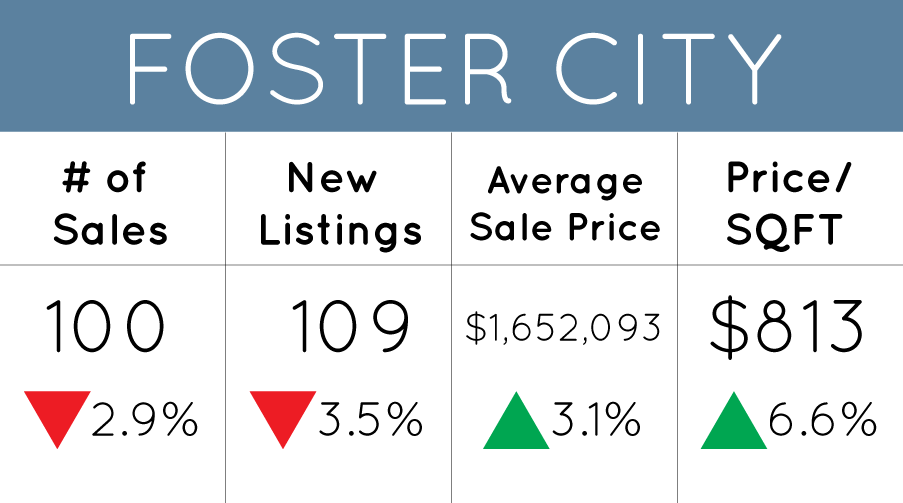
See blow for a snapshot summary of the 2016 mid-peninsula real estate market.  All percentages reflect the change from 2015 values.


2017 Real Estate Market: A Look Ahead


With Donald J. Trump sworn in as our 45th President on the steps of the Capitol Building this morning, now seems as good a time as any to ruminate on the future (of the real estate market).  Two indicators to closely monitor this year will be the stock market and interest rates.  After taking a quick dive immediately after Trump's victory was announced in early November, the stock market surged to finish off the year.  If this trend continues, it will boost the buying power of some home buyer hopefuls, especially here in the Silicon Valley where it seems everyone over the age of 30 has a stock portfolio.  Still, despite recent stock market performance, a new president and new economic policy bring with them a degree of uncertainty.  For now, expectations of decreased regulation and taxes have investors feeling optimistic about the Trump presidency.  

Rising interest rates could be the real story of the 2017 real estate market.  The Fed finally raised rates in December for just the second time in the past decade.  And just yesterday, Fed Chair Janet Yellen said she expects a few more rate hikes throughout the year.   With this being said, the Fed will only continue to raise rates if they are confident in our economy, which to a certain degree will hinge upon policy pushed through in the early goings of the Trump Presidency.  If rates do in fact continue to rise,  the increased cost to borrow could have a stabilizing effect on home prices in 2017.  

For better or worse, 2017 is sure to be a year full of surprises!  Stay tuned to my monthly newsletter for updates on the mid-peninsula real estate market as the Trump presidency progresses.

Thursday, December 15, 2016

San Carlos to Put a Stop to Lot Splits

In response to concerns about increasing neighborhood density, the San Carlos Planning Commission recommended last week that the city revert to pre-2011 development standards, which were much more stringent on minimum lot sizes.  This change would increase the minimum lot sizes from 5,000 S/F to 10,000 S/F, and lot width from 40 to 65 feet.  It also puts restrictions on flag lots, which are parcels of land at the end of a long driveway with no road frontage.  The Planning Commission voted 5-0 in favor of this recommendation.

Zoning changes made in 2011 allowed construction of larger homes, and for homeowners of lots 10,000 S/F of more to split their lots in order to increase the city's supply of housing.  They allowed for homes to cover 50% of the total lot square footage, rather than the 40% permitted under pre-2011 zoning laws.  In addition to allowing for the construction of larger homes, the increased lot coverage makes constructing accessory dwelling units possible for more homeowners.

The city had already placed a moratorium on the 2011 zoning changes back in June.  This was in response to resident complaints that homes were being built too large on lots that were too small, and that lots splits were leading to too much neighborhood density.

San Carlos, like most cities on the peninsula, has seen a recent surge in housing demand due to nearby job growth.  This has attracted the attention of developers and builders who see that there is money to be made in San Carlos.   But increasing density is hardly ever a popular idea in small close-knit communities like San Carlos, so it's not much of a surprise to see residents push back against more relaxed zoning laws.

Thursday, December 8, 2016

Facebook Pledges $20 Million to Affordable Housing

Last week, Facebook announced they will spend $20 million to help alleviate the housing shortage in their neighbor cities of Menlo Park and East Palo Alto. About $18.5 million will go towards building new housing, mostly targeted at low/middle income families, while the rest will go towards job training programs and providing legal assistance to tenants facing eviction. This announcement comes as Facebook and other tech giants have been facing growing pressure to partner with local governments and community organizations to find solutions to the region's housing shortage - a problem which many feel has been exacerbated by unchecked tech growth.

Bird's eye view of Facebook's recent campus expansion.  Chilco Street is the only thing separating it from East Menlo Park's Belle Haven community (visible in the top left)

Facebook's rapid expansion into East Menlo Park, a historically low-income region, has been a point of contention as of late.  Early in 2015, they opened up a brand new 430,000 S/F Frank Gehry designed campus expansion within shouting distance of East Menlo Park's Belle Haven community.  Almost immediately after they cut the ribbon on that building, they submitted plans to the City of Menlo Park to redevelop an adjacent property into roughly 1 million square feet of additional office space.  That project - also Frank Gehry designed - was promptly approved, and construction has been underway for over a year now.  With all of this new office space to put to use, Facebook has estimated that they will bring 6,500 new employees to the area in the coming years.

A coalition of local community organizations had planned to sue Facebook over the stress 6,500 new employees could put on an already overburdened housing market.  However, after a series of meetings with Facebook representatives, they agreed not to.  Tameeka Bennett, executive director of Youth United for Community Action, one of the groups in the coalition, said she is convinced that Facebook is committed to partnering with the community to address the housing shortage.  And more so than any of their Silicon Valley peers, their actions have demonstrated as much.

Facebook's recent $20 million announcement isn't the first commitment they have made to combat the housing crisis.  Last year, in partnership with St. Anton Development, they broke ground on a 394-unit apartment complex at 3639 Haven Avenue.  Those units will be offered to non-Facebook employees, and 15 of them will be subsidized by Facebook for low-income families.  They extended their commitment to constructing publicly available housing earlier this year, when they unveiled a proposal to build 1,500 total units, 15% of which would be reserved for low to middle income families.  This hands on approach to tackling the housing shortage is completely breaking the mold of how Silicon Valley tech companies offer support to communities impacted by their growth.  While it is fairly common for companies to pay "impact fees" to help fund affordable housing, it is unprecedented for them to actually build the housing themselves.

To be fair, this isn't a completely altruistic effort on the part of Facebook.  Housing costs in the Bay Area have made it increasingly difficult for companies like Facebook to recruit the talent they want, so adding to the supply of housing serves their interests by driving those costs down and making it easier for them to recruit.

Perhaps others will follow Facebook's lead.  There are certainly plenty of eyes on Google in Mountain View, and Apple in Cupertino, hoping they will make similar efforts.  Stay tuned

Friday, November 4, 2016

New Redevelopment Proposal Submitted for Old Redwood City Theater

screenshot-2016-11-03-13-04-26
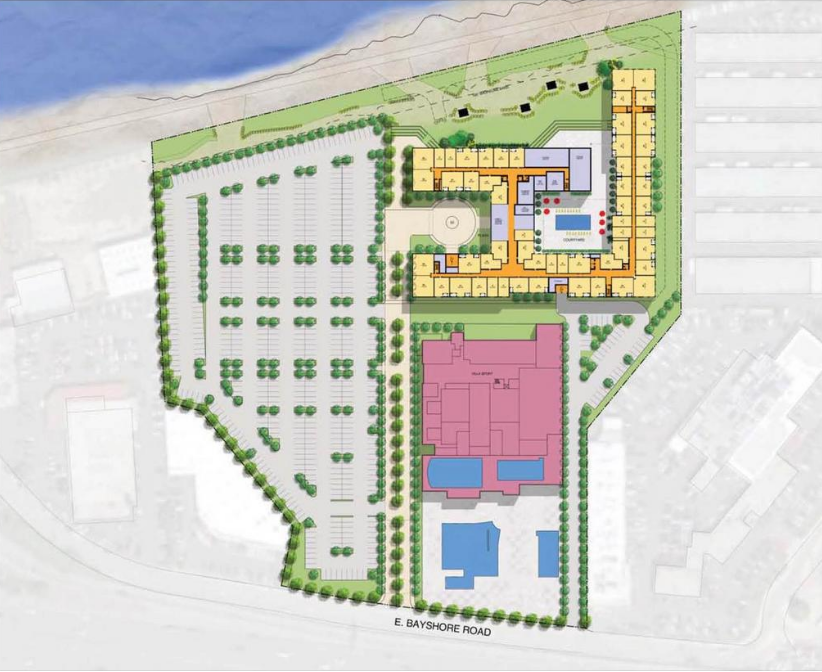
SyRes Properties, LLC - the company that owns Redwood City's defunct Century 12 Theater - recently submitted plans to redevelop the 15-acre property into 336 residential units and a 100,000 S/F luxury sports club.  This is a revision of a plan they submitted to the city last year which originally proposed 550 residential units.  At the time, city officials told SyRes that 550 units needed further review and would require the land the be rezoned for high density development.  Previous attempts to redevelop the land into rental units and auto dealerships have all fallen through.
“We've received a revised application and it's currently considered conceptual at this point", said Lisa Cost-Sanders, the city planner assigned to the project.  "We'll be providing the developers with additional comments and will be restarting the Environmental Impact Report process shortly.”
SyRes is the real estate branch of the Syufy family, who are known for their chain of Century Theaters.  In recent years however, the family has begun redeveloping their older cinemas into luxury VillaSport athletic clubs, as they are in the process of doing with an old theater in San Jose, and are currently hoping to do in Redwood City.  They currently operate three active VillaSports in Texas, Colorado, and Oregon, with single adult monthly dues ranging in price from $92 - $138 (expect that to be higher at Bay Area locations).
Other than serving as extra parking for neighboring auto dealerships, the property formerly occupied by Century 12 Redwood City has remained mostly vacant since the theater closed in 2003.  Should the recent SyRes proposal pass, it will become the second major development along Redwood City's bayfront, with One Marina Homes just a stone's throw away. However, even with the reduction in proposed residential units from 550 to 336, this project is sure to be put under heavy scrutiny by city officials for it's potential to further congest the Highway 101/Whipple junction.  It also comes at a time when city hall is facing growing pressure from the community to put the brakes on development.
This proposal is by no means a slam dunk for the Syufy family, who have had no luck getting anything approved for their property at 557 East Bayshore.  Stay tuned to our blog for further updates on this project.

New Wine Bar & Cafe Open at Box HQ, Redwood City

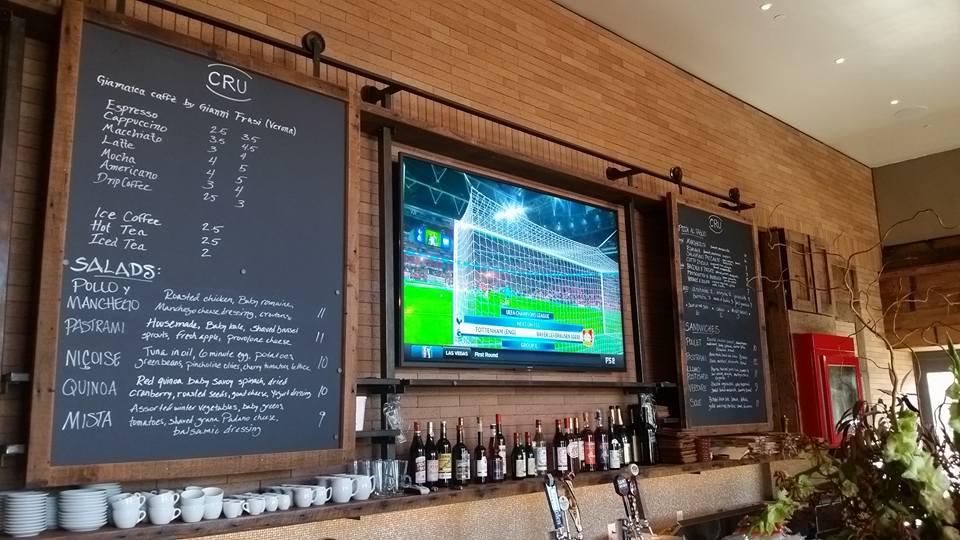
Donato Scotti, owner of Donato Enoteca in downtown Redwood City, has opened a wine bar, retail store & cafe at the new Box Headquarters at 900 Middlefield Road.  Cru Wine Bar & Merchant offers hard to find wines from around the world, as well as an international and domestic craft beer selection.  A European style menu featuring charcuterie plates, pizza by the slice, sandwiches and other treats are served as well.
The first day of service was November 2nd.  The cafe opens at 8am, and lunch service begins at 11am - stop by and check it out!