Tuesday, October 27, 2015

RWC Releases Draft Inner Harbor Specific Plan, Requests Public Input

1-3HNSfeG6ztGVBKoIL6-LCQ
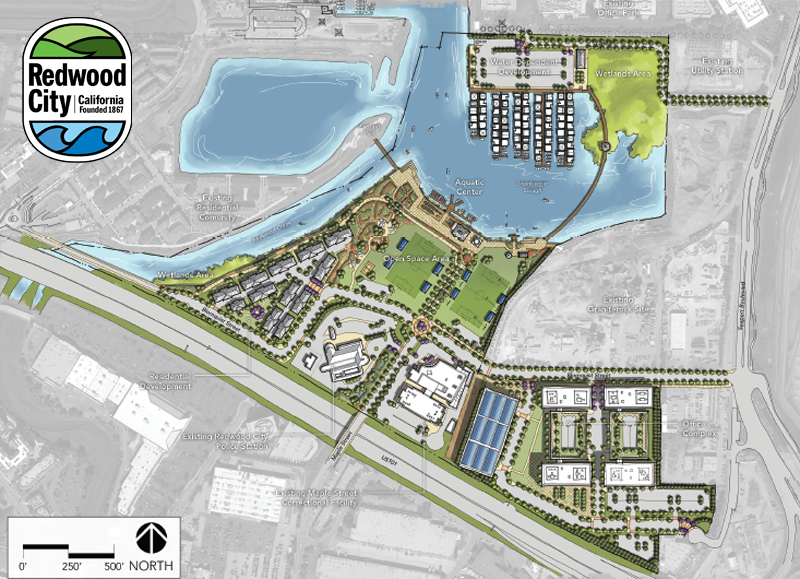
Yesterday, Redwood City released to the public the Draft Inner Harbor Specific Plan (DIHSP) and the associated Draft Environmental Impact Report (DEIR).  These documents, and other information pertinent to the development of the Inner Harbor, can be viewed at www.redwoodcity.org/innerharbor.
The Inner Harbor is a 100-acre plot of land north of Highway 101, in-between Redwood Creek and Seaport Boulevard.  The Inner Harbor Specific Plan, just like the Downtown Precise Plan, is intended to provide guidance for the future development of the area.  Its general objective is to create a destination harbor center with areas for homes, recreation and employment.
In addition to studying the environmental impact of the land usage proposed in the DIHSP, the DEIR also includes impact reports for alternative land use possibilities.  It isn't common for the Draft Plan, Draft EIR, and Draft alternatives to be released all at once, but it was done deliberately to give the public and decision makers plenty of time to digest all of the information before the adoption process.  The released drafts cover the following topics: baseline conditions, vision framework, land use and zoning, design guidelines and standards, circulation and parking, utilities, community benefits, and implementation.
The community will have plenty of chances to voice their opinions/concerns about the plan.  The Draft EIR is under a 90-day review period, during which time the public is encouraged to send in written questions and comments.  In addition, the Planning Commission will be holding a public meeting on December 1st at 7pm in City Hall to receive further comments and questions.  All questions received at the meeting and in writing during the 90-day review period will ultimately be included and responded to in the final EIR.
Additional venues for community input will be established in the coming months - to stay updated, check in periodically to the Inner Harbor Website referenced above.

Wednesday, October 21, 2015

MBA Predicts Nationwide Surge in Housing Demand

As the real estate market has steadily climbed in the bay area, the question is always…how long with the expansion last?  As always, the job market in the local region continues to support our strong economy, but how is the rest of the country doing..and what is the countries overall future real estate prognosis?  I'm not an expert for this question, so I looked to an entity that is.

A recent report released by the Mortgage Bankers Association forecasts a huge surge in housing demand over the next 10 years, with somewhere between 13.9 and 15.9 million additional households expected to form by 2024.  If the projections made in the report were to play out, we would be looking at one of the strongest housing markets in U.S. history.

The MBA's report claims that the surge in new household formation - and the resulting spike in demand - will be driven primarily by Hispanics, baby boomers, and millennials.

"Household formation has been depressed in recent years by a long, jobless recovery and by a lull in the growth of the working age population," said Lynn Fisher, MBA's vice president of research and economics. "However, improving employment markets will build on major demographic trends - including maturing of Baby Boomers, Hispanics and Millennials - to create strong growth in both owner and rental housing markets over the next decade."

The millennial demographic has been slow to break into the housing market (as owners), as many have spent a lot of time in school, and have put off major life events like getting married and having children.  But as more and more millennials head into their 30's and onward, it is widely expected these trends will shift in favor of increased household formation.  The MBA report predicts that millennials - which they describe as ages 18-44 to account for 10 years of aging - will form 4.1 - 5.1 million new households over the next ten years.

What's interesting to note, is during the early 1970's, when a large portion of the Baby Boomers were in their mid-20's (prime renting years), we saw the biggest multi-family construction boom in the country's history.  In the late 70's - when that same demographic matured, started families, and began buying homes - we saw one of the country's biggest single-family construction booms.  So if history is any indicator, as the millennial generation matures, the resulting increase in single-family demand could lead to a similar construction boom.
   

Tuesday, October 20, 2015

Will the Fed Rate Increase Affect Bay Area Buyer Demand?

Since the beginning of the year, there has been endless speculation about when the Fed was going to increase interest rates. First it was mid-year, then it was September, and now some say it won’t be until next year. Sooner or later it is bound to happen, but the question is: how much will it affect the market here in the Bay Area?

When the Fed increases interest rates, banks tend to eventually increase their loan rates. Generally when this happens some amount of buyers are pushed out of the market - less demand equals lower prices. But in regions like the Bay Area, where the housing market is saturated with buyer demand, it would take a pretty large jump in rates to throw any sort of wet blanket over the market. And with the Bay Area nearing full employment (unemployment < 5%), and incomes generally on the rise, there is plenty of reason to believe that any effects on buyer demand resulting from a rate increase would be negligible.

What we may see is a slight spike in demand in the coming months, as borrowers try to lock in their rates in anticipation of the Fed increase. Either way, the effect of the Fed’s impending rate increase on the Bay Area’s housing market should be minimal.

If you have any questions regarding the impending Fed increase and what it may do to your purchasing power, feel free to give me a call.  I'd be happy to refer you to one of my trusted loan advisors.

Monday, October 5, 2015

Should You be Worried When Your Mortgage is Sold?

If you have taken out a mortgage, chances are you've received statements from companies other than your lender.  For some people this can be a little off-putting, but don't fret! Mortgages are regularly sold by lenders to investors like Freddie Mac, Fannie Mae, Hedge Fund companies, and the like.    Lenders do this as a way of generating the extra cash they need to be able to offer more loans.  On the investor’s side, purchasing mortgages is appealing because unlike many other investment opportunities, they are backed by a tangible asset - a house.  For the most part homes tends to increase in value, and if they don't, and the borrower defaults on the loan, the down payment is intended to cover the loss.  

While it may make you a little uncomfortable to think that your loan can change hands without your knowledge or consent, there is actually nothing to worry about.  When your loan is sold, its new owner has to adhere to the same terms and conditions that you agreed upon with the lender.  The Real Estate Settlement and Procedures Act, which is enforced by the CFPB, ensures that mortgages cannot be modified without the borrowers consent, even if they are sold to another company.

Also, the CFPB has laid out industry standards on how to collect on delinquent mortgages.  These standards are designed to protect the struggling borrower, and they apply even when a mortgage is sold.  They require the servicer to give the borrower options such as loan modification or a short sale before they pursue foreclosure.

So to sum things up - although your mortgage can be sold without your consent, it's terms and conditions cannot.  It may still seem a little bizarre, but there is no reason to be alarmed when you get a statement in the mail from a company with which you have never done business.  

Wednesday, September 9, 2015

Design Tech High Coming to RWC August 2017

dtech
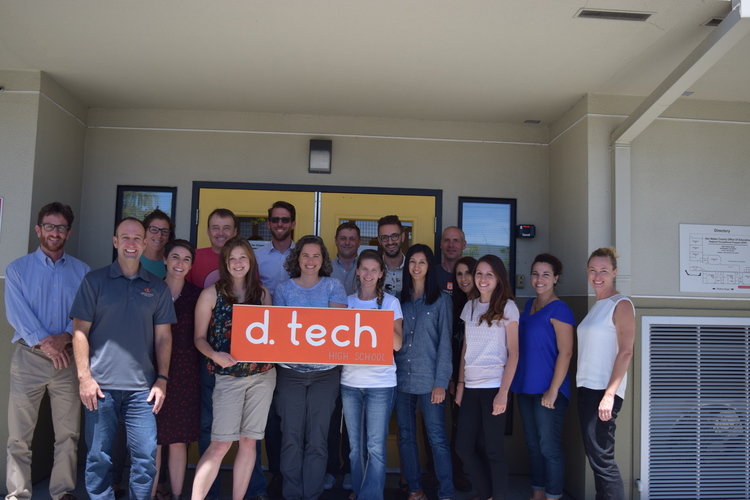
Design Tech High Faculty - Founder, Dr. Ken Montgomery, pictured 2nd from left.
Design Tech High School, which opened just last year on the campus of Mills HS in Millbrae, is hoping to set up shop on Oracle's RWC campus by August 2017.  The move will call for the construction of their own 75,000 S/F school.  And according to Colleen Cassity, Executive Director of Oracle Corporate Citizenship, Oracle will provide the land and completely fund the school's construction, adding that education has long been a philanthropic focus of the company.
“We see great potential in Design Tech High School’s model and we’re in a unique position to provide a permanent home to support the school,” Cassity said.  Oracle likes the school’s education approach of teaching students to use “design thinking and to develop creative confidence,” she added.
The Oracle Education Foundation had already given a $75,000 grant to d.tech High prior to their announcement that they would be footing the bill for the school's new home.
D.tech High is an innovative free public high school authorized by the San Mateo Union High School District.  Dr. Ken Montgomery founded the school on the idea that while the world around us has changed so much over the years, schools haven't.  So d.tech High incorporates "technology, design thinking, and a focus on non-cognitive skills to help students forge an identity that will help them as students, professionals, and citizens".
By the time the school makes their move to Oracle campus, they estimate their size will be around 550 students and 30 faculty.
D.tech will be a welcome addition to Redwood City's diverse selection of high schools,  which already includes the number 7 state ranked Summit Preparatory HS.   To top it off, the construction of d. tech will come at no cost to tax payers - thanks Oracle!

Wednesday, September 2, 2015

What Happened to the Depot Circle: The Downtown Precise Plan's Defining Project

When Redwood City adopted the Downtown Precise Plan in 2011, one of it's major components was what was known at the time as the Depot Circle.  The city envisioned the "Depot Circle" as a massive multi-building, mixed-use development that would cover two parcels of city-owned land known as "Block 2" and "The Winslow Street Parking Lot".  The defining feature of the development would be [not so surprisingly] the Depot Circle - which in the city's words, would be "a public open space intended to create a welcoming and exciting entrance to Downtown from the train station".  Below is a summary of available information on the progression of the Depot Circle Project: 

August 2011 - A request for qualifications document is released by Redwood City to solicit interest from development teams to develop two city owned parcels of land: "Block 2" and "The Winslow Street Parking Lot" (both parcels can be seen in the graphic below).  Potential uses for the project are listed as office, residential, hotel, retail, restaurants, and entertainment.  


December 2011 - After receiving 5 responses to the request for qualifications document, the city invites two developers to submit detailed proposals for the project: Hunter/Storm and Lowe Enterprises.

May 2012 - The city chooses the Hunter/Storm proposal as the preferred scenario, and plans are made to move forward with a development agreement.  The Hunter/Storm proposal is a development ranging in height from 4-9 stories that includes 261,000 S/F of office space, 3,000 S/F of retail, a 120 room hotel, and 810 parking spaces.  Pictured below is the birds eye view of the Depot Circle Project provided in Hunter/Storm's 2012 proposal:


Since the May of 2012, the city has not publicly released anything referring to the Depot Circle.  However, in late 2013 Hunter/Storm did break ground at the Block 2 parcel.  We know that development now as Crossing/900, and it is slated to open for business this October.  Crossing/900 includes over 300,000 S/F of office space, just over 5,000 S/F in retail, and 904 parking spaces that will be open to the public evenings, weekends and holidays.  According to Redwood City's website, it also includes a public plaza, which one would assume will serve as the "welcoming and exciting entrance to Downtown from the train station" they referred to at the time of the Depot Circle idea's inception in 2011.

For whatever reason, Hunter/Storm abandoned the hotel portion of their proposed development, which presumably would have been built on the Winslow Lot.  But interestingly enough, a proposal for a 200 room hotel at the Winslow Lot was submitted by none other than Lowe Enterprises - the developer that lost the bid on the Depot Circle Project.  The hotel was even included on the development map published in the May 2015 issue of Redwood City Climate Magazine.  But that project has since hit a potentially fatal roadblock...

August 2015 - Just last week, the city announced that they are putting the brakes on the hotel proposal in light of the sheer volume of construction that is already taking place in the downtown area.   Mayor Jeffrey Gee also expressed that they were finding it difficult to design a hotel with enough parking on the 46-space Winslow parking lot.  Instead, the city now wants public opinion on potential uses for the lot.  Starting early 2016, residents, business owners, and property owners will be invited to engage in a series of community workshops, City Council meetings,  and online surveys to hopefully figure out the best use for the lot.  The only thing that is out of the question at this point is additional office space - the cap of office space allowed under the Precise Plan has already been reached.

So even though the city hasn't released any information on exactly what happened with the Depot Circle Project since Hunter/Storm submitted their proposal, it is clear that somewhere along the way plans changed.  Crossing/900 accounts for all (and then some) of the commercial, retail, and parking space that was called for in their original proposal, but the future of the Winslow Street Parking Lot now seems to be in limbo.  Eventually it is likely that something will be built there, but not for some time.  Meanwhile, the parcel of land directly in between Block 2 and the Winslow Lot on the backside of the Fox Theater (labelled as "Future Lot" in the first graphic) has been approved as a mixed-use office/retail development.  I've talked more about this development in a recent blog.

Hotel or no hotel, Depot Circle or Crossing/900, it looks like one way or another the corridor of land walking you from the train station to Theater Way should turn out to be a pretty impressive Gateway to Downtown.  We'll get our first glimpse of what this will look like when Crossing/900 opens late next month. 

Thursday, August 27, 2015

SF-Redwood City Metro Area Among Best for Millennial Workforce

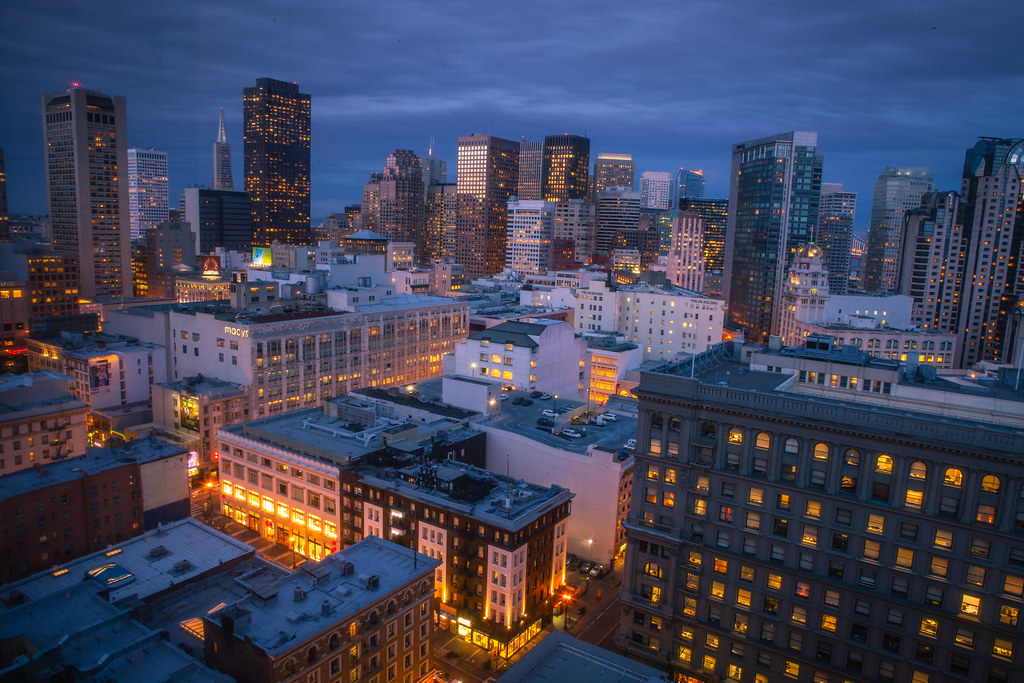
San Francisco by anhgemus, on Flickr
Creative Commons Creative Commons Attribution-Noncommercial 2.0 Generic License   by  anhgemus 

Seattle-based online benefits and compensation firm, Payscale, recently ran a study in which it pulled data from 650,000 surveys filled out by millennials (those born between the years 1982-2002).  The question they were attempting to answer was, "where are millennials most likely to find the most rewarding jobs"?  The factors they took into consideration were: median pay for millennial workers, unemployment rate in the area (as of June '15), median commute time, percentage of millennials reporting high job satisfaction, and the percentage reporting low job stress.
The study found that the San Francisco metro-area, which they refer to as "San Francisco-San Mateo-Redwood City, was the 2nd most likely place for a millennial to find a rewarding job - behind only the Seattle metro, and just ahead of 3rd place San Jose metro.  However, I suspect there was some favoritism at play, as the SF metro actually ranked as high or higher than Seattle on most of the variables in the study.  Our median pay for millennials was listed at $69,700 (vs. $55,000 in Seattle), unemployment at 3.4% (vs. 4% in Seattle), and the share of satisfied workers at 70% (same as Seattle).  The only variables in the study that Seattle might best us on is commute time and job stress.
I'll concede to Seattle on commute time.  I don't have any experience commuting in Seattle, but we all know how backed up traffic can get around here.
But as for job stress?  I'M NOT STRESSED!!! JUST LEAVE ME ALONE, OK??!!
In all seriousness though - Seattle is a rapidly growing tech hub with companies like Amazon, Microsoft, and Zillow calling it home, and many others opening up offices.  There was even an article floating around a few months ago claiming that tech workers were leaving SF and the Silicon Valley for a more manageable cost of living in cities like Seattle and Austin, which I addressed in a past blog.  But my stance now, as it was then, is that the SF Bay Area/Silicon Valley is the undisputed tech capital of the world, and nothing stands to change that any time soon - especially with tech giants like Google, Facebook, Yahoo, Youtube, Linkedin, Twitter,  and Apple continuing to grow here at mach speeds.
Maybe it is reckless to equate the tech workforce with the millennial workforce.  But since the two are so intrinsically linked, I feel comfortable saying that as long as the SF Bay Area remains #1 in tech, we remain the #1 haven for the millennial workforce.