Friday, September 15, 2017

To Stage or Not to Stage

You’re getting ready to sell your home and your Realtor recommends staging it prior to going on the market. You think to yourself: ‘Why waste the money? We’re in a seller’s market, and I have a beautiful home that should sell no problem, with or without staging.’ Well, you might be right, but the question isn’t whether staging will be the difference between your home selling or not. The question is whether staging will increase the likelihood of your home selling quickly and at the highest price the market will bear. In cases where the home isn’t a complete fixer, the answer to that question is usually yes.

First impressions mean a lot in real estate, even in a highly competitive market like the Bay Area. For a buyer to feel confident writing their highest and best offer for your property, you want them to feel at home as soon as they walk through the front door. Needless to say, it’s hard for most people to feel comfortable in a dark and empty house. If one of our clients has a vacant home, we almost always hire a professional stager to furnish it before going on the market.


If you currently live in the house you’re selling, “staging” becomes more a matter of rearranging furniture, decluttering and hiding/removing personal effects. As much as your home feels like home to you, it might not feel that way to the next family. Whether vacant or owner occupied, it’s important to present a neutral living space that appeals to the broadest demographic of buyers possible.

Wednesday, September 13, 2017

Foster City Must Upgrade Levee or Become Flood Zone


Flooding and flood insurance is the top of the news stories with the multiple hurricanes arriving on the Florida coastline. Here in California, we don’t think too much about hurricanes or flooding, but the latter may be more of a reality than we are aware of. We live in the Bay Area - aptly named as our cities surround approximately 1600 square miles of “bay” water - and while hurricanes don't pose much of a flood threat here, rising bay levels do. One bayside community is currently at the middle of a battle to protect their city from flood hazards, as well as the costly insurance premiums that come along with them.

Foster City officials are currently mulling over their options for updating the levee running between their city and the bayfront. The Federal Emergency Management Agency (FEMA) had previously certified the levee as providing the city with sufficient protection from flood risk, but a new study found that due to rising water levels roughly 85% of the levee no longer meets FEMA standards. As a result, most of the city could be designated as a flood zone unless appropriate updates are made to the levee.

A flood zone designation would have an immediate impact on Foster City’s real estate market. Any property purchased with federally backed loans would require a flood insurance policy, which can cost thousands annually, depending on the property. Homeowners would also have to disclose the flood insurance requirement when selling, which could adversely affect property values. Fortunately for homeowners, the city is taking steps to make sure this doesn’t happen.

We recently hosted Foster City Community Development Director, Curtis Banks, at one of RealSmart's weekly networking meetings. He explained to us that FEMA granted Foster City a "seclusion mapping" designation in 2015, which has allowed them to temporarily avoid the flood zone designation so long as they show they are taking steps to improve the levee. Since then, he says Foster City has held 37 public, regulatory and general project meetings to decide how much to invest in raising the levee - the higher they raise it, the longer they will be protected from rising sea levels. It’s worth noting that in 2010, Redwood City spent about $2.7 million adding 1-2 feet to about 8 miles of levee in the Redwood Shores community. At the time, the city predicted sea level rise would mandate another round of improvements in 20 years.

Continual levee improvements/maintenance are a burden that fall on many Bayside peninsula communities, not just Foster City. Whether or not these communities do enough to maintain their levees could be the difference of thousands of dollars every year to homeowners. Something to keep in mind if you own a home, or are looking to buy a home in places like Redwood Shores or Foster City, where FEMA accredited levees are the only thing standing between you and a costly flood insurance policy…….or the bay.

Tuesday, August 29, 2017

Stanford Purchases RWC Property for $39.5 Million

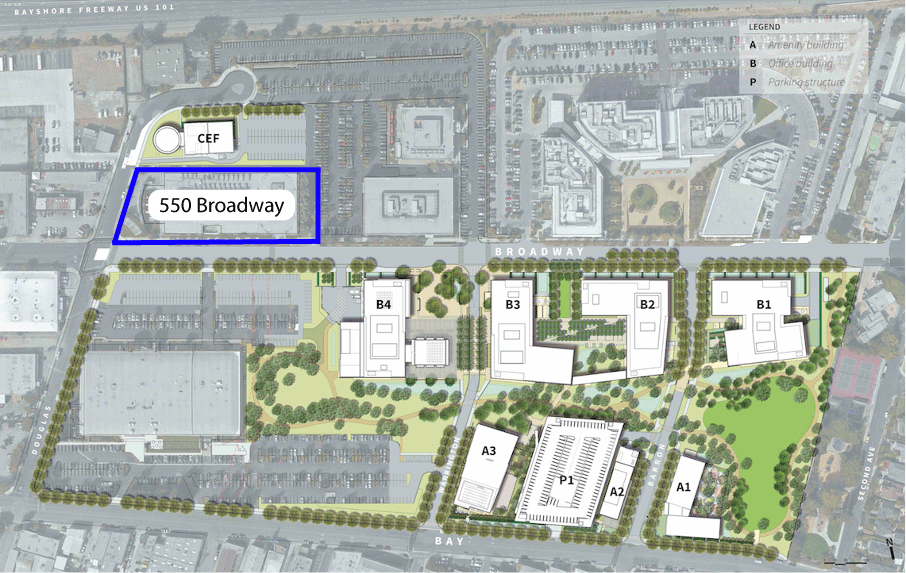
Stanford University has officially purchased the last piece of the 35-acre puzzle that will become "Stanford in Redwood City".   550 Broadway, a nearly 2.5-acre parcel last home to a data center and administrative office for Genentech, was purchased by Stanford in an off-market sale last month for $35.9 million, according to public record.  It joins 1228 Douglass Ave, and 405, 425, 475, 500-585 Broadway as addresses slated for redevelopment in Stanford's first major campus expansion.

It is unclear at the moment what Stanford's long term plans are for their most recently acquired piece of Redwood City real estate, but it does not look like it will factor into phase one of the Stanford in Redwood City project, which broke ground December of last year.  According to a report from the Silicon Valley Business Journal, the University is currently exploring leasing out the site's existing 68,000 square foot building on a short term basis.

Phase 1 of the Stanford in Redwood City project is projected to finish sometime in 2019.  Once completed, it will feature four office buildings, a town square and park (open to the public), outdoor dining areas and plazas, a child care center, a parking garage, a glass atrium fitness center, and its own sustainable central utility plant.  Some improvements to the surrounding roadways and intersections are included in phase 1 as well.  Pictured below is an overview of the phase 1 layout, with the recent acquisition at 550 Broadway highlighted in blue.


There is no set timeline beyond phase 1, but when it's all said and done Stanford's first major campus expansion will feature 13 buildings, totaling roughly 1.5 million square feet of office, medical clinics, and R&D space.  Further, as part of the University's development agreement with Redwood City, they have pledged $15.1 million in public benefits.  

The Redwood City campus will mirror the look and feel of the Palo Alto campus, and much of the ground will be open to the public.  The University's free shuttle service will be accessible to the public as well.

Stay tuned for updates.

Monday, August 7, 2017

Tesla Looking to Set Up Shop in Redwood City

An architect working on behalf of Tesla has filed an application with Redwood City to redevelop 515 Veterans into a sales office, warehouse, and service center/garage. The 23,000 square foot site, located at the corner of Whipple and Veterans, is currently home to Crunch fitness and Chef Peking, a Chinese restaurant.

Rough sketch of Tesla's proposed project

In order for the pioneering electric car manufacturer to use the land as desired, the site's zoning will have to be amended to add Vehicular Combination Zoning District to its existing Industrial Park zoning.  City staff are currently reviewing the environmental implications of such a zoning change at 515 Veterans, but as the company notes in their proposal:
"Servicing an electric automobile is different from servicing a gas-powered car. Tesla’s vehicles have no internal combustion engine. This vehicle is exclusively electric and is not hybrid. Accordingly, there is no exhaust system, no fuel tanks, no liquid fuel usage, no new or used motor oil, no noise from the vehicle, and no emissions like hydrocarbon and carbon monoxide that are emitted from an automobile powered by an internal combustion engine. Instead of an engine, an electric motor powers Tesla’s vehicles. Electric motors require little to no maintenance.”
With this in mind, it's probably safe to say that Tesla isn't terribly worried about how their electric car service station will stand up to environmental scrutiny.

I wouldn't expect the public review phase to be very rigorous either - this project wouldn't be displacing any housing opportunities (as the land is not zoned for residential), it isn't likely to introduce any more traffic to the area than the existing gym and restaurant, and the surrounding area is already home to several auto dealerships and service centers.  So unless Tesla backs out, my money says it's only a matter of time before Redwood City is welcoming one of Silicon Valley's most iconic and innovative companies to its workforce.

Why Redwood City?

Tesla's desire to open a shop in Redwood City is likely part of a larger effort to increase their sales capacity.  They just started delivering their most affordable car yet - the Tesla 3 - to customers in July, and demand for the car reportedly far exceeds the number of cars available.  On Monday, they announced they would be raising $1.5 billion through their first ever offering of "junk bonds" in order to get the cash necessary to ramp up production of the Tesla 3 sedan.   As production increases and Tesla becomes a more accessible and mainstream auto manufacturer, they will likely look to set up additional service and sales centers to accommodate demand.

Stay tuned to my blog for updates as this proposal progresses through city review.


Friday, July 28, 2017

Zoning Amendment Sought for Massive Inner Harbor Office Project

Last week, Redwood City officials voted 4-2 to explore amending the city's General Plan to allow for the construction of nearly 1.2 million square feet of office space along the Redwood Creek.  The amendment is being sought by developer Jay Paul Co, who hopes to build four 7-story office buildings on the 27-acre site, which is currently zoned for light industrial and port use only, with a maximum building height of 3 stories.  The office space would be designed with tech and R&D firms in mind.
In addition to the 4 office buildings, the proposal calls for surface parking at each building, two parking structures, and landscape improvements, including a new park with sports fields.  Most Redwood City residents will remember the site of this proposed project as the former home to Malibu Golf & Grand Prix, but this massive development would also span the land that Lyngso used to occupy, as well as a lumber supply company and gas station.
In a July 10th letter sent by Jay Paul to the city, the developer outlined over $40 million in community benefits, and $32 million towards measures that would mitigate the project's environmental impact. The project's benefits would include $10 million toward the Woodside/Highway 101 interchange improvement project; $10.1 million for the Blomquist Bridge and street extension project, plus a commitment to pay the full $24 million needed “while additional funding sources are identified;” $5 million for the development of an inner harbor public park with new sports and recreational facilities; $2.1 million for bicycle paths; and $2.25 million for a new free public shuttle. Mitigation measures include $15.8 million in housing fees, $5.5 million in sewer and water fees, and $2.5 million in traffic impact fees.
Despite the bounty of public benefits packaged with Jay Paul's proposal, numerous residents spoke out against the development at last week's meeting, mostly for it's lack of housing, and for tech and R&D firms being perceived as a poor fit in the Inner Harbor community.  Both Vice Mayor Ian Bain, and Councilwoman Janet Borgens voted against the proposal.
This vote was only to approve looking into the zoning amendment further, and does not itself authorize a zoning amendment.  City staff will prepare a draft environmental impact report, which will be reviewed at a future Planning Commission meeting, before being brought back to city council for review.
Stay tuned.

Thursday, July 20, 2017

131 Townhouses Proposed Along RWC Waterfront

On Tuesday night Redwood City Council discussed a proposal to develop 131 three-story townhouses at 1548 Maple Street, a 7.9 acre stretch of land running along the city's waterfront.   The project would be adjacent to the Docktown Marina, which currently houses about 65 floating homes that the city is currently in the process of vacating/relocating.

The proposal also includes improvements to the section of the Bay Trail that run through the site.

Tuesday night's meeting featured the usual concerns that surround new residential development in Redwood City: affordable housing and traffic.  All 131 of the townhomes would be offered for sale at a market rate, so as it stands the project offers no consideration for affordable housing.  Commissioner Connie Guerrero asked that the developer come back with a proposal that included affordable housing, as well as an alternate proposal for a downsized project.

Another member of the Planning Commission, Shawn White, requested information on how school enrollment at Taft Elementary, and traffic along the 2.5 mile route to the school, would be affected by the development.  White suspected that since the project consists of single-family townhouses rather than apartments, it is more likely to attract young families with children.  Taft would be the elementary school that most families living at the complex would be assigned to.

The project's approval would also require the city to grant a zoning change from tidal plain to mixed-use.  The Planning Commission has already spent quite a bit of time studying zoning changes in that area during their drafting of the Inner Harbor Specific Plan, and while the IHSP was never completed, the hopes are that they can use those reports to guide them in studying a zoning change for this project.

Comments and concerns about the environmental impact of this project can be sent to lcostasanders@redwoodcity.org through Aug. 7, with future opportunities to weigh in once an environmental impact report is prepared and subsequent public hearings are held.


Wednesday, July 12, 2017

Redwood City Updates/Expands Neighborhood Associations Map

Redwood City recently announced an update to its neighborhood association map - expanding the number of neighborhoods from 11 to 17. This new map was designed to better align with the city's natural boundaries and neighborhood characteristics, as well as recognize and blend several pre-existing maps, including the General Plan Neighborhood Map, the previous Neighborhood Association Map, and the Nextdoor Neighborhood Map.

The new map include the addition of the Bair Island and Downtown neighborhoods, where the vast majority of new residential development has been concentrated over the past several years. Also, some of the larger neighborhoods have been broken up into smaller ones. For example, what was previously the High School Acres neighborhood is now recognized as a combination of Mt. Carmel, Eagle Hill, and Edgewood. Similarly, Central Park has been split into Woodside Plaza, and Palm. These new neighborhoods might actually be more familiar than the older ones colloquially, but they are just now being recognized by the city with their own designated neighborhood associations. 

Redwood City Residents: The city is currently in the process of appointing leaders to each association, and establishing regular meetings. They encourage all residents to take a look at the new map to determine which neighborhood association you belong to, as these associations are key in driving communication between city officials and the community. For information on how to register with your new neighborhood association, or how to get involved as a leader of your community, head to: http://www.redwoodcity.org/residents/neighborhoods/neighborhood-associations.